Humans are legion on the internet. Yet, while they have never been alone in surfing the web, computers have never been so omnipresent. Now, with generative artificial intelligence, it’s common to see machines—or at least texts written by them—interacting with us humans.
The loss of human interaction
There have always been, and always will be, people who struggle to express themselves in writing online (though not exclusively). However, while even the most academic among us once had to put real effort into writing a post, it’s now increasingly common to see posts published by humans but written by AI.
Take the example below:
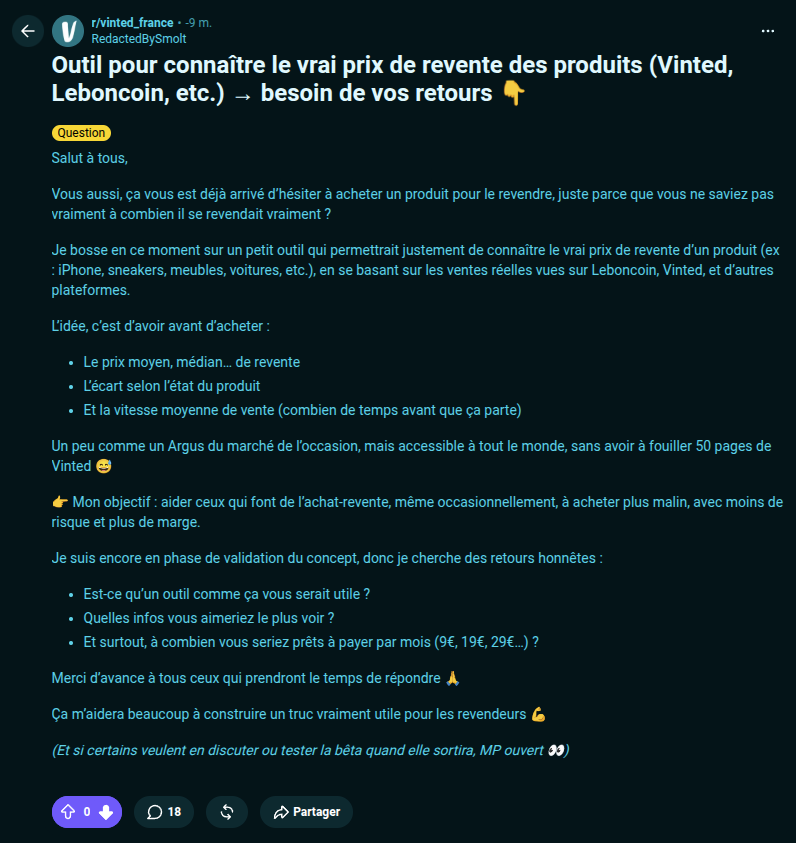
Maybe nothing stands out to you. Yet, this message was written by an AI. It’s easy to spot thanks to the overuse of emojis, the bullet-point lists that flow like a single sentence, and the closing line. It’s not an exact science, but anyone who spends as much time online as I do can tell the difference in the blink of an eye.
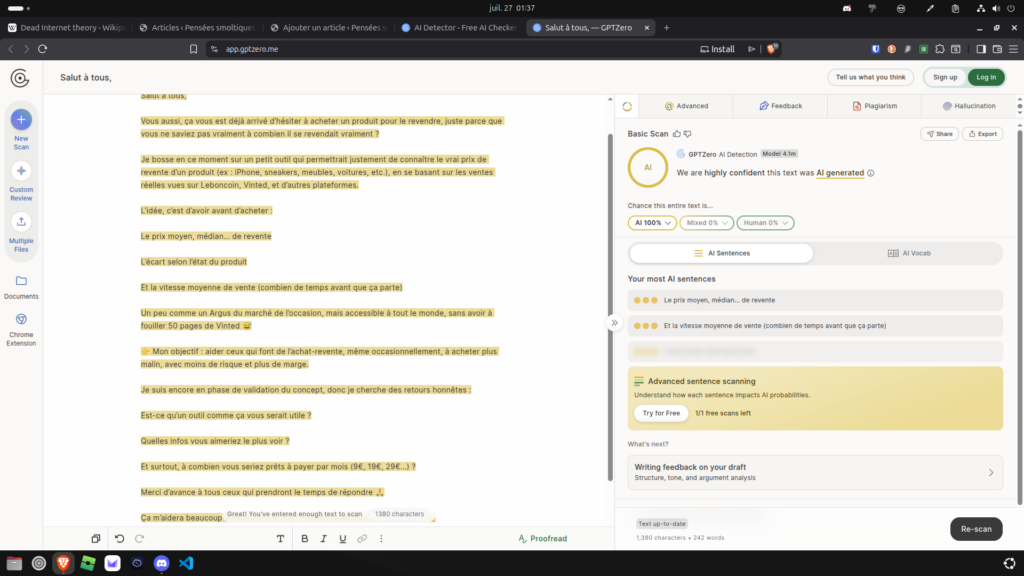
As confirmation, an AI detector confirms my hunch. These detectors aren’t infallible either, but this one seems reliable and helps support my point.
These AI-written messages are terribly rude. It’s like telling other users, 'I didn’t have time to write my post, but you must take the time to read this indigestible wall of text and respond to it.' Disgusting.
AI at the service of businesses
Let’s set aside the job losses caused by AI—it’s not the topic here. Companies use it to automate the creation process in their communications. We’re talking about mass-produced, low-cost ads flooding the internet. You’ve surely seen plenty of them.

Photo by AcrobaticLead8042 on Reddit.
This ad should be a textbook example of what not to do in communication! Even ignoring the yellowish filter on the image, typical of OpenAI’s image generation, the resolution is terrible, and the poster is saturated with useless information. That’s because AI doesn’t know, so it improvises generic text that’s probably true but adds nothing to the visual.
Yet last December, Intermarché proved it’s possible to create beautiful ads. This one was so buzzworthy that many internet users watched it voluntarily, and the media covered it as well.
In this era disrupted by AI, consumers are happy to find authenticity again. Currently, this video—which, by the way, is an ad—has 151,000 likes.
Finally, using AI is a lack of consideration for the customer. Customer service chatbots are full of them. While these bots may have access to the same knowledge bases as customers and can offer advice, they have no power to act and are utterly incapable of solving even the simplest problems.
Bots as political weapons
Bots have been around as long as the internet. There have always been some, and there always will be. However, they are becoming increasingly sophisticated and have become real tools capable of manipulating public opinion with the rise of AI.

For example, here a Russian bot uses artificial intelligence to debate by taking the context of a TikTok video. It was exposed by a user who asked it to forget its system prompt to give them... a recipe. The bot complied, something a human would never have done.

Leave a comment